

Why Evisu Jeans Became a Streetwear Icon

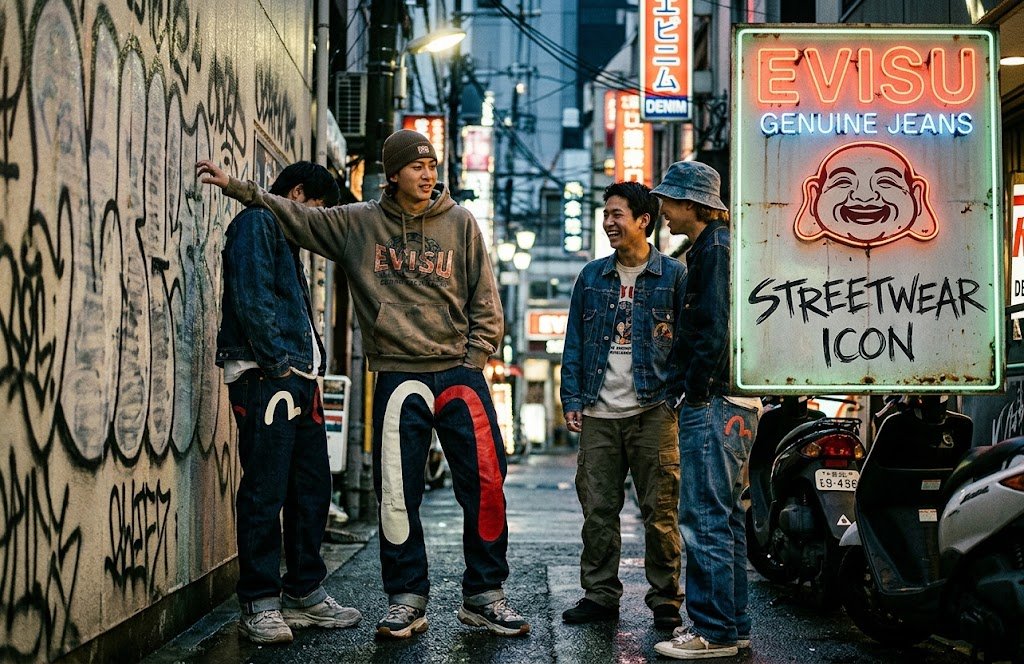
Why Evisu Jeans Became a Streetwear Icon is a story about much more than expensive denim. Founded in Osaka in 1991 by Hidehiko Yamane, EVISU built its identity around Japanese craftsmanship, vintage American denim references, hand-painted details, and an instantly recognizable Seagull mark.
What made the brand different was the way those ingredients moved beyond denim circles. Evisu Jeans became recognizable in hip-hop, fashion, and eventually skateboarding because the clothing communicated something immediately: this was denim designed to be noticed.
Unlike a conventional pair of jeans where branding might remain subtle, early Evisu made craftsmanship part of the visual experience. The hand-painted pocket graphics, distinctive silhouettes, substantial denim, and Japanese interpretation of American workwear gave the jeans an identity that could be recognized from across a room.
That combination helped EVISU move from a small Osaka operation into an internationally recognized name. Its story also reveals an important lesson about streetwear: sometimes the strongest cultural influence comes from a product that was not originally designed to become a streetwear uniform.
Add a link to your Japanese denim or Evisu Jeans collectio
Why Did Evisu Jeans Become So Popular?
The simplest answer is that Evisu Jeans combined heritage, craftsmanship, scarcity, and visual recognition at exactly the right moment.
EVISU began in Osaka in 1991, during a period when Japanese designers and enthusiasts were deeply interested in American clothing history. The brand’s official history says its name comes from Ebisu, the Japanese god of prosperity, while its early jeans were hand-painted with the now-famous Seagull logo.
The early operation was remarkably small. EVISU states that approximately 14 pairs of jeans were originally produced each day, with the Seagull painted onto each pair.
That detail matters because it helps explain why early EVISU felt different from mass-market denim.
The jeans weren’t simply products coming from a large production line. Their visual character was closely connected to the person making them.
Japanese craftsmanship met American denim heritage
EVISU’s approach was rooted in an appreciation for vintage American denim, but Yamane interpreted that heritage through a Japanese lens.
This was part of a broader Japanese fascination with American casual style. Japanese consumers and designers had spent decades studying American workwear, Ivy style, military clothing, and classic denim, often paying extraordinary attention to construction and historical details.
EVISU took that obsession and turned it into something more expressive.
Instead of simply reproducing vintage jeans, the brand made its interpretation highly visible.
The result was denim that could satisfy enthusiasts interested in construction while also appealing to people who wanted a bold fashion statement.
How Did the Evisu Seagull Logo Change Denim?
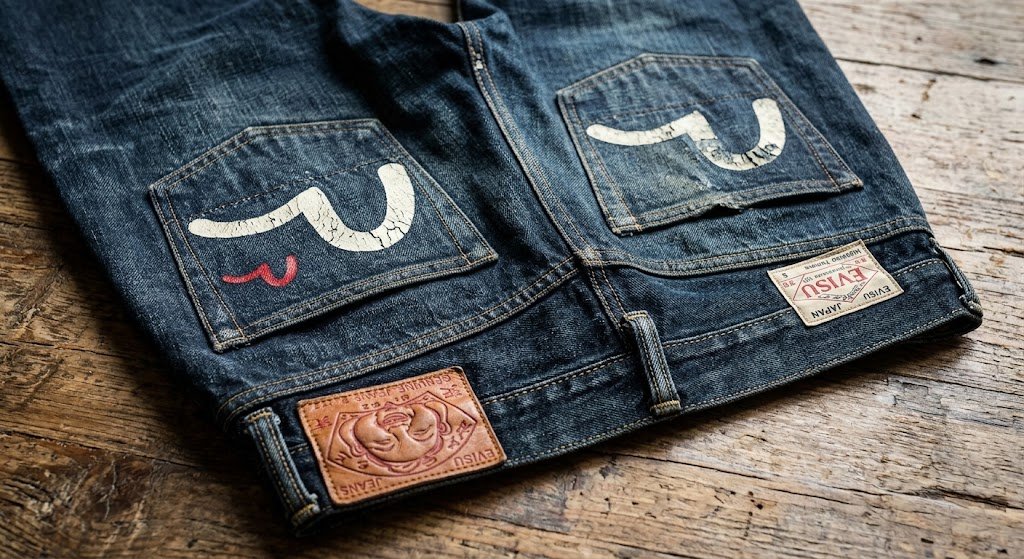
The Evisu Seagull logo became one of the brand’s greatest advantages because it transformed the back pocket into a recognizable piece of visual communication.
EVISU’s official history specifically identifies the hand-painted Seagull as one of the defining characteristics of its early jeans.
The idea sounds simple: paint a curved mark across the pocket.
But the effect was unusual.
Traditional denim branding often depended on relatively restrained details. EVISU did almost the opposite. Its pocket graphics could be large, colorful, hand-finished, and immediately visible.
That made the jeans identifiable even when the wearer was walking away.
The Seagull became a visual signature
This is one of the most important reasons Evisu Jeans translated so well into streetwear.
Streetwear relies heavily on visual recognition. A sneaker, jacket, cap, or pair of jeans can become culturally significant when people recognize it without needing to see the label.
The Seagull achieved exactly that.
My editorial takeaway from comparing the brand’s history with its later street-culture presence is that the logo functioned almost like a visual handshake between different subcultures. Denim collectors could appreciate the construction; hip-hop audiences could recognize the status signal; skaters could appreciate the oversized silhouette and distinctive graphics.
The same pair of jeans could communicate something different to each group.
That flexibility is a major part of EVISU’s cultural staying power.
How Did Hip-Hop Turn Evisu Jeans Into a Status Symbol?
Hip-hop played a major role in moving EVISU from specialist denim culture into broader streetwear.
By the late 1990s and early 2000s, Japanese denim was increasingly visible outside Japan. EVISU’s distribution and exposure in fashion centers such as London and New York helped the brand reach consumers who were looking for something different from mainstream American denim. Independent reporting on the brand’s history notes that prominent rappers including Jay-Z and Lil Wayne helped reinforce EVISU’s association with street culture.
This was a powerful combination.
Why rappers connected with the brand
Evisu Jeans offered several things that worked particularly well within hip-hop fashion:
- A recognizable logo
- Oversized and distinctive silhouettes
- Premium positioning
- Japanese craftsmanship
- Limited-feeling or collectible designs
- A strong contrast with ordinary mass-market jeans
The jeans therefore operated as more than basic clothing.
They became part of an outfit’s statement.
Independent fashion coverage also documents EVISU’s growing connection with rap culture and its eventual popularity among American artists.
This exposure was especially important because hip-hop was becoming an increasingly powerful influence on global fashion during this period.
When a recognizable artist wore a product, audiences didn’t necessarily see it as advertising. They saw it as part of the artist’s personal style.
That distinction matters.
EVISU didn’t need to look like traditional luxury fashion to acquire premium status. Its exaggerated denim became desirable precisely because it belonged to a different visual language.
How Did Evisu Jeans Enter Skate Culture?
One of the more interesting chapters in the story is EVISU’s relationship with skateboarding.
The brand was not originally created as a skate brand. Its founder’s early focus was vintage American denim, construction, fabric, and hand-finished details rather than skateboarding.
Yet EVISU eventually appeared in the skateboarding world.
Why?
Because skate culture, hip-hop, fashion, music, and streetwear increasingly overlapped during the late 1990s and early 2000s.
Yokogao’s research into EVISU and skate culture points to the brand appearing in skate footage and being worn by highly visible skaters whose style existed at the intersection of skateboarding, music, nightlife, and fashion.
EVISU did not need to become a skate brand
This is an important distinction.
EVISU’s appeal in skateboarding came partly from the fact that it didn’t look like conventional skatewear.
The brand already had cultural credibility elsewhere.
A skater wearing a pair of wide, graphic-heavy Evisu Jeans wasn’t simply wearing “skate jeans.” They were bringing another cultural influence into skateboarding.
That is how fashion often spreads.
A garment doesn’t necessarily need to be designed for a particular subculture before that subculture adopts it.
What Made Evisu Denim Different From Ordinary Jeans?
The appeal of Evisu Jeans cannot be explained by the logo alone.
The underlying denim and construction were essential to the brand’s reputation.
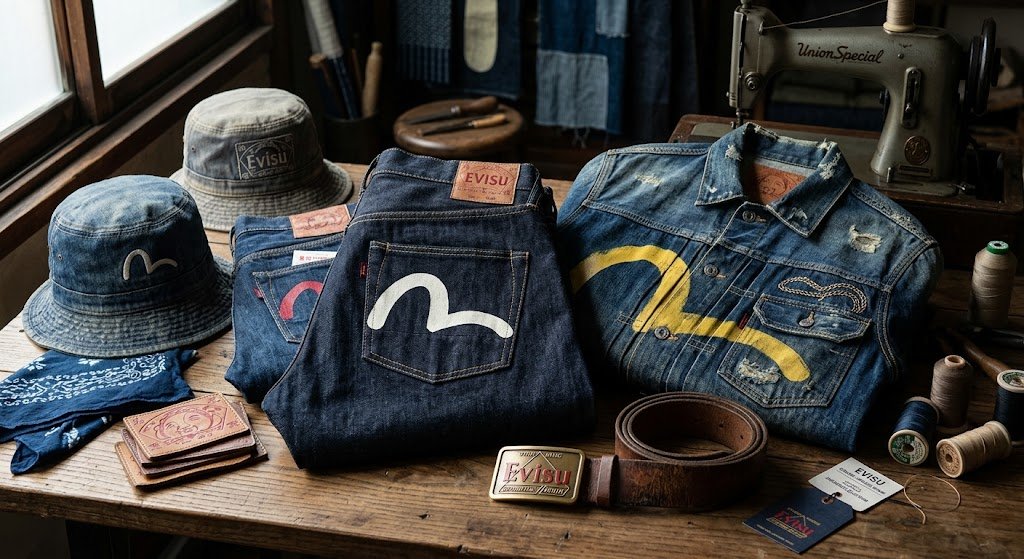
EVISU describes itself as an early premium Japanese selvage denim brand, with a focus on quality and craftsmanship.
Selvedge denim
Selvedge denim is produced using a traditional narrow-width weaving process that can create a finished edge on the fabric.
For denim enthusiasts, selvedge is interesting because the fabric’s construction, texture, weight, and aging characteristics can become part of the ownership experience.
EVISU placed that craftsmanship inside a much louder visual package.
That combination is important.
Some Japanese denim brands are admired primarily for understated construction. EVISU added an unmistakable graphic identity to its denim.
Hand-finished details
The hand-painted pocket treatment was particularly significant.
The official brand history emphasizes that early pairs were individually painted.
This gave the jeans an element of variation that factory-perfect mass production does not naturally provide.
The paint itself also became part of the aging story.
As jeans are worn and washed, the denim changes. The contrast between fading fabric and the pocket graphic can make older examples visually different from newer ones.
That is one reason vintage EVISU jeans has developed a collector following.
Why Were Evisu Jeans So Important to 2000s Streetwear?
The early 2000s were an unusually important period for streetwear.
Hip-hop had enormous cultural influence, skateboarding was becoming increasingly visible through magazines and video releases, and Japanese fashion was gaining international attention.
EVISU sat directly in the middle of these movements.
The brand’s history shows a progression from Japanese denim enthusiasts to international recognition, while later reporting documents its movement into hip-hop and skate culture.
The important point is that EVISU didn’t have only one audience.
It could be understood as:
Japanese denim by a denim enthusiast.
Luxury streetwear by a fashion buyer.
A status symbol by a hip-hop fan.
A bold silhouette by a skater.
That overlapping identity gave the brand unusual cultural reach.
The power of being recognizable
Streetwear thrives on pieces that are easy to identify.
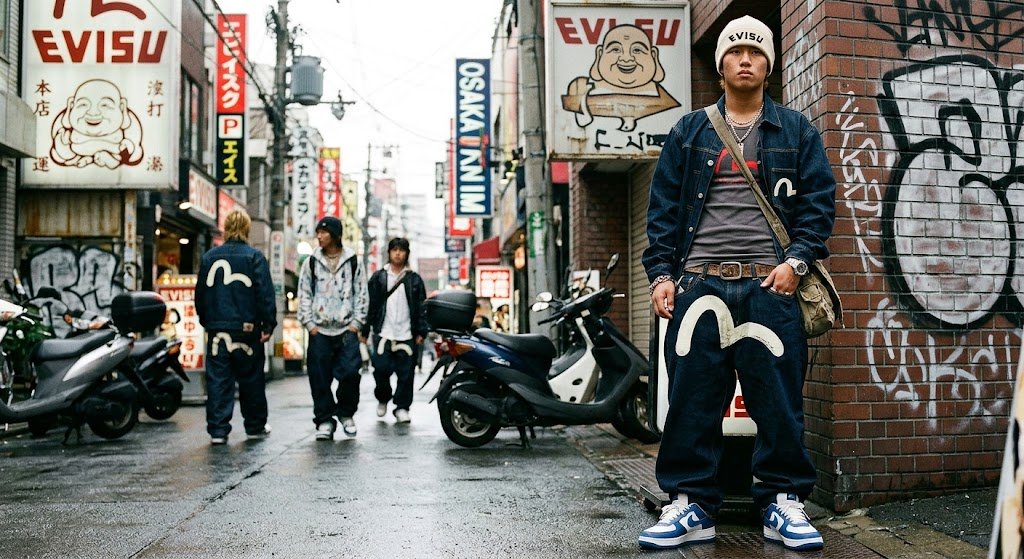
Evisu’s pocket graphics, distinctive fits, and premium positioning made the jeans unusually photogenic. In magazines, music videos, photographs, and skate footage, the denim could communicate its identity without requiring a close-up of the waistband.
That is a major reason the brand remains visually memorable decades after its launch.
How Did Evisu Keep Its Identity While Fashion Changed?
One reason EVISU remains relevant is that it has not depended entirely on nostalgia.
The official brand history documents later collaborations and cultural partnerships, including a collaboration with London’s Palace Skateboards.
That matters because collaboration has become one of the central mechanisms of modern streetwear.
A heritage brand can either preserve its identity so rigidly that it becomes a museum piece, or it can reinterpret its recognizable elements for new audiences.
EVISU has repeatedly used the second approach.
The Seagull remains recognizable, but its presentation can change through different washes, graphics, silhouettes, collaborations, and collections.
This is also why the brand can appeal simultaneously to vintage collectors and younger fashion consumers.
Are Evisu Jeans Still Relevant Today?
Yes, but their relevance has changed.
In the early 2000s, part of the attraction was discovery. Wearing Evisu could signal that you knew about a relatively specialized Japanese brand that was becoming increasingly visible in American popular culture.
Today, consumers have access to far more Japanese denim brands and information than they did two decades ago.
That makes EVISU’s historical importance even easier to understand.
It was one of the brands that helped demonstrate that Japanese denim could become a global cultural product rather than simply a specialist category.
The current EVISU brand continues to sell denim alongside broader apparel categories, while maintaining its connection to its original identity.
Evisu Jeans vs. Other Streetwear Denim Brands
What separates EVISU from many other denim labels is the combination of technical credibility and visual excess.
A simple comparison helps:
| Feature | Evisu Jeans | Typical mainstream denim |
|---|---|---|
| Japanese denim heritage | Strong | Varies |
| Hand-painted pocket graphics | Defining feature of early EVISU | Rare |
| Visual branding | Highly recognizable | Often more restrained |
| Selvedge association | Important to brand heritage | Not universal |
| Streetwear influence | Strong | Depends on brand |
| Collector interest | Significant for certain pieces | Usually lower |
| Hip-hop association | Strong historical connection | Varies |
This does not mean every Evisu product is automatically better than every competing pair of jeans.
It means EVISU occupies a particular position.
The brand combines the seriousness of Japanese denim with the attitude of graphic streetwear.
That combination is difficult to reproduce convincingly.
What Is the Real Reason Evisu Became a Streetwear Icon?
The answer is not simply “because celebrities wore it.”
Celebrity exposure helped, but it came after EVISU already had a distinctive product.
The deeper reason is that the brand created something people could recognize, discuss, collect, and wear as an identity statement.
Its story follows a powerful sequence:
- Japanese enthusiasts rediscovered American denim heritage.
- EVISU developed a highly crafted interpretation of that heritage.
- The hand-painted Seagull became a recognizable signature.
- The brand reached international fashion markets.
- Hip-hop helped transform the jeans into a status symbol.
- Skate culture absorbed the look through overlapping urban style networks.
- Later collaborations introduced the identity to new audiences.
That is the real formula behind the brand’s longevity.
EVISU didn’t simply follow streetwear.
It became one of the brands that helped define what premium streetwear denim could look like.
Conclusion: Why Evisu Jeans Still Matter
Why Evisu Jeans Became a Streetwear Icon ultimately comes down to the meeting of Japanese craftsmanship and global street culture.
Founded in Osaka in 1991, EVISU began with a focused interest in premium denim and vintage American references. Its hand-painted Seagull logo gave the jeans an unmistakable visual identity, while the brand’s craftsmanship gave enthusiasts a reason to care about what was underneath the paint.
Hip-hop expanded that identity into mainstream street culture. Skateboarding later absorbed the look through the increasingly connected worlds of music, fashion, and urban style.
The result is more than a successful denim label.
EVISU represents a particular moment when Japanese craftsmanship, American denim heritage, hip-hop, skateboarding, and global fashion began influencing each other at unprecedented speed.
That is why the Seagull is still recognizable.
And that is why Evisu Jeans remain an important chapter in the history of streetwear.
Add a link to your Evisu Jeans collection or Japanese denim buying guide
3. FAQ Section
1. Why did Evisu Jeans become popular?
Evisu Jeans became popular because they combined Japanese denim craftsmanship with bold hand-painted pocket graphics, distinctive fits, and strong cultural exposure through hip-hop and streetwear.
2. What is the Evisu Seagull logo?
The Evisu Seagull logo is the brand’s signature curved pocket graphic. Early EVISU jeans were individually hand-painted with the recognizable mark, helping make the brand visually distinctive.
3. Are Evisu Jeans Japanese?
Yes. EVISU was founded in Osaka, Japan, in 1991 by Hidehiko Yamane and built its early identity around Japanese craftsmanship and vintage American denim influences.
4. Did hip-hop influence Evisu Jeans?
Yes. EVISU gained significant visibility through American hip-hop culture in the late 1990s and early 2000s. Coverage of the brand’s history documents associations with prominent rappers and the wider streetwear movement.
5. Did Evisu Jeans influence skate culture?
EVISU was not originally created as a skateboarding brand, but its distinctive denim appeared within early-2000s skate culture. Its connection to hip-hop, fashion, and urban style helped the brand move naturally into skateboarding’s visual culture.
6. Why are Evisu Jeans considered collectible?
Certain Evisu Jeans are collectible because of their Japanese denim heritage, distinctive hand-painted graphics, historical importance, limited-feeling production, and connection to early-2000s streetwear culture. Collectibility varies considerably by age, model, condition, rarity, and provenance.
One thought on “Why Evisu Jeans Became a Streetwear Icon”