
How to Spot Authentic Evisu Jeans vs Fake (Complete Guide)


How to Spot Authentic Evisu Jeans vs Fake (Complete Guide) starts with one important rule: do not judge a pair from one detail alone. Authenticity is strongest when several independent details agree, including the seller, construction, labels, denim, hardware, patch, and signature back pocket artwork.
Evisu is particularly interesting for authentication because its jeans span different eras, collections, production locations, materials, and design treatments. That means a detail that looks unusual on a newer pair may be completely normal on an older one. EVISU itself says its jeans use authentic materials, vintage detailing, and traditional production methods, while its official guidance highlights denim, threads, selvedge, buttons, labels, and pockets as important parts of its construction.
This guide focuses on the practical Evisu Jeans vs Fake checks that can help a U.S. buyer evaluate a pair before spending money.
How to Spot Authentic Evisu Jeans vs Fake: Start With the Seller
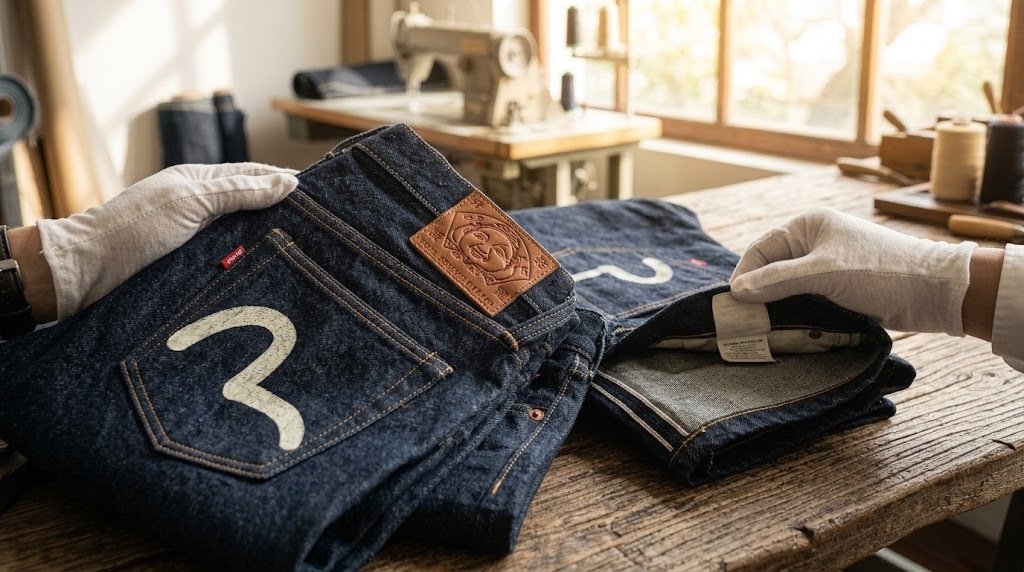
Before examining stitching or denim, investigate where the jeans came from. This is one of the most overlooked parts of authentication.
EVISU advises customers to purchase genuine products through its official online store and authorized retailers. Its counterfeiting page specifically warns shoppers about unverified products sold by unauthorized retailers.
For a secondhand purchase, ask:
- Does the seller provide photos of the actual jeans?
- Is the seller willing to show close ups of the tags and patch?
- Is there a clear return policy?
- Does the seller have a consistent transaction history?
- Does the listing use only official stock photos?
- Is the price dramatically below comparable authentic pairs?
- Does the seller avoid answering questions about provenance?
The FTC also recommends researching unfamiliar sellers, checking complaints, reviewing the complete listing, and keeping purchase records. It notes that unusually cheap brand name products can be a warning sign of counterfeit merchandise.
Why Price Alone Cannot Prove a Fake
A low price is a warning, not proof.
Used Evisu jeans can vary substantially in value depending on age, condition, model, artwork, size, rarity, and market demand. A heavily worn pair may legitimately sell for much less than a rare special release.
Conversely, an expensive pair can still be fake.
Think of price as a risk signal, not an authentication test.
Check the Evisu Seagull or Daicock Carefully
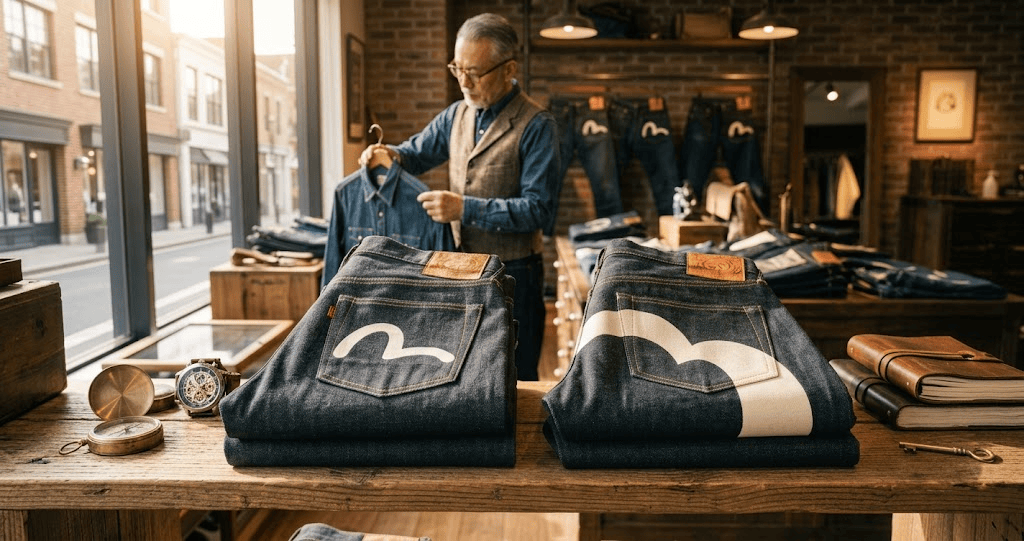
The back pocket artwork is one of the first details most buyers notice. EVISU describes the back pocket seagulls as a major symbol of its craftsmanship and notes that the artwork can be hand painted, printed, or embroidered depending on the product.
That last point matters.
A common mistake in Evisu Jeans vs Fake checks is assuming every authentic pair must have exactly the same seagull treatment. Different releases can use different techniques.
What to Examine
Look closely at:
- Shape and proportions
- Placement on the pocket
- Paint or embroidery texture
- Edge definition
- Symmetry
- Signs of natural wear
- Relationship between the artwork and pocket stitching
Do not automatically reject a pair because its seagull is imperfect. Hand applied artwork can show variation, and older pairs can have cracking, fading, peeling, or repainting.
Community authentication discussions illustrate why this matters. Collectors have identified genuine older Evisu examples with unusual rubberized seagull paint that cracked or peeled with age.
Red Flags
Be cautious when the seagull:
- Looks like a flat generic print on a model expected to have another treatment
- Is badly positioned
- Has unusually poor edges
- Uses inconsistent embroidery
- Appears artificially aged
- Does not match the claimed model or era
The key is model consistency, not perfection.
Inspect the Godhead Patch and Leather Details
The Godhead patch is another important checkpoint.
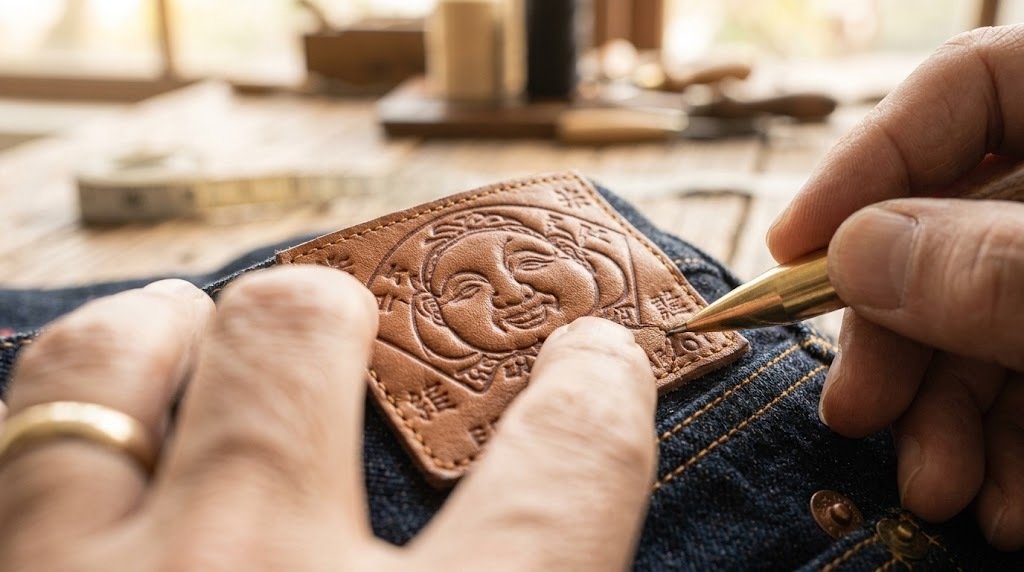
EVISU’s own “Evisu Rules” identifies the Godhead patch as a signature label element. The patch represents EVISU’s association with Ebisu, the Japanese god of prosperity, and can appear in different materials and formats.
Look at the patch from several angles.
Check the Patch For
Material:
The material should make sense for the particular release. Do not assume every authentic Evisu pair uses identical leather.
Embossing:
Characters and artwork should have convincing depth rather than looking like a cheap, shallow stamp.
Typography:
Inspect the lettering, numbers, and spacing closely.
Attachment:
Look at how the patch is attached to the waistband. Uneven construction, suspicious stitching, or an incorrect placement can add to a counterfeit case.
Model information:
If a No. or Lot reference appears on the patch, compare it with the rest of the jeans and any available product information.
A useful lesson from recent community legit checks is that even convincing patches are not enough by themselves. Experienced collectors often request photos of the buttons, rivets, selvedge, embroidery, and internal labels before reaching a conclusion.
Examine the Denim, Selvedge, Stitching, and Construction
EVISU’s official construction guidance places significant emphasis on selvedge denim and traditional shuttle loom production. The brand says its selvedge is usually red and white, although authentication should still account for the specific product and era rather than treating one selvedge color as a universal rule.
Feel the Denim
Authentic denim should feel appropriate for its stated construction.
Look for:
- Consistent weave
- Appropriate weight
- Clean texture
- Solid structure
- Quality finishing
- Convincing fading on worn pairs
A thin, plasticky, or strangely uniform fabric deserves further investigation.
However, fabric feel alone cannot prove authenticity. Denim weights and compositions vary between Evisu releases.
Inspect the Selvedge
If the jeans are represented as selvedge, inspect the inside edge carefully.
Look for:
- Clean selvedge finishing
- Consistent weaving
- Proper edge construction
- A believable relationship between the denim and claimed model
Do not confuse alterations with counterfeit construction. A previous owner may have had the jeans hemmed, repaired, or modified.
One older Reddit legit check shows why this distinction matters: commenters noted that an altered hem could explain construction that otherwise appeared unusual.
Study the Stitching
Run your eyes along:
- Back pockets
- Waistband
- Belt loops
- Yoke
- Inseam
- Outseam
- Pocket bags
- Hem
Loose threads do not automatically mean fake. Vintage and heavily worn jeans can develop loose stitching, and authentic examples from certain eras may not have the pristine finish buyers expect from a new premium garment.
The stronger warning is multiple construction inconsistencies appearing together.
Check Buttons, Rivets, Zippers, and Other Hardware
Hardware is easy to overlook and surprisingly useful when performing a detailed Evisu legit check.
EVISU’s official guidance says the brand uses unique buttons based on original designs, including its Victory Stud.
Inspect:
- Button face
- Button back
- Rivet shape
- Engravings
- Finish
- Weight
- Placement
- Zipper hardware where applicable
A counterfeit pair may reproduce the visible branding but use generic hardware underneath.
That is why photographs of both sides of the button, the rivets, and other hardware are valuable when buying online.
A Better Hardware Test
Do not ask only, “Does this button look like Evisu?”
Ask:
Does the hardware agree with the claimed model, era, and other construction details?
That question produces a much stronger authentication process.
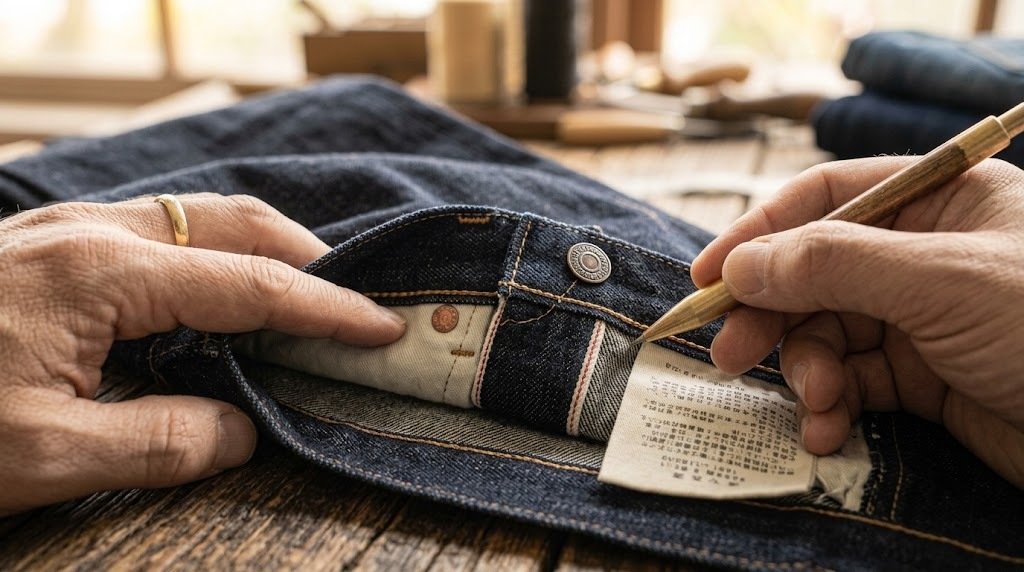
Verify the Internal Tags and Labels
Internal labels can expose inconsistencies that are difficult to see from product photos.
Check:
- Brand spelling
- Typography
- Print sharpness
- Tag material
- Stitching
- Placement
- Care information
- Style or model information
- Country of manufacture
- Any codes or identifiers present
A particularly useful comparison is between the clarity of the internal print and the quality of the rest of the jeans.
Collectors have pointed out differences in label crispness when comparing authentic Made in Macau examples with questionable pairs.
Do Not Use Country of Manufacture as a Standalone Test
This is an important authentication rule.
A label showing a production country that differs from what you expected is not automatically evidence of a fake.
Evisu has released products across different periods and collections, and community discussions document legitimate examples with different production histories. For example, collectors have discussed authentic International Evisu examples associated with different production periods and locations.
Instead, ask whether the entire label package makes sense for the specific model and era.
Compare the Entire Pair With the Claimed Model
This is where a basic legit check becomes a serious one.
Suppose a seller claims the jeans are a particular Evisu model. Do not compare them only with a random pair found on Google Images.
Compare:
- Back pocket artwork
- Patch design
- Button and rivet configuration
- Internal tags
- Denim construction
- Fit and silhouette
- Pocket construction
- Country and production information
- Decorative embroidery
- Wash or finishing treatment
This approach fills a major weakness in simple fake guides: authenticity is contextual.
A real Evisu pair can look “wrong” if you compare it with a different generation.
Likewise, a convincing counterfeit can look “right” if you check only one familiar feature.
Original Insight: Use the Five Point Agreement Test
After years of working around fashion products and product identification, one practical method I recommend is to divide an Evisu check into five independent categories:
Brand artwork + patch + construction + hardware + provenance
If four or five categories agree, confidence increases.
If three categories disagree, stop treating one attractive detail as proof of authenticity.
This is not an official Evisu authentication formula. It is a practical decision framework designed to prevent tunnel vision.
Evisu Jeans vs Fake: Common Mistakes Buyers Make
Mistake 1: “The Seagull Looks Good, So They Are Real”
Counterfeiters know the seagull is recognizable.
A good looking seagull is only one data point.
Mistake 2: “The Jeans Are Made in Japan, So They Are Authentic”
Country of origin is not a complete authentication test.
Always evaluate the model, labels, construction, and provenance together.
Mistake 3: “The Patch Is Leather, So It Must Be Real”
A counterfeit can reproduce a patch convincingly.
Inspect the patch’s artwork, embossing, attachment, and consistency with the rest of the jeans.
Mistake 4: “Any Loose Thread Means Fake”
Wear, repairs, production differences, and age can affect construction.
Look for patterns of poor workmanship instead.
Mistake 5: Trusting Stock Photos
If the seller will not provide clear photos of the actual item, walk away.
The FTC recommends checking actual product information and seller details when buying through online marketplaces.
How to Check Evisu Jeans Before Buying Online
Ask the seller for these photos:
- Full front
- Full back
- Both back pockets
- Godhead patch
- Waist label
- All internal labels
- Button front
- Button back
- Rivets
- Selvedge
- Hem
- Any embroidery
- Any model or style information
Save the listing, seller information, messages, payment record, and photos.
If the seller refuses reasonable authentication photos, that is useful information by itself.
For a high value purchase, consider an independent authentication service rather than relying entirely on an online comment section.
What Should You Do If You Think Your Evisu Jeans Are Fake?
Do not immediately alter, wash, sell, or throw away the jeans.
First:
- Photograph every identifying detail.
- Save the original listing.
- Save seller messages.
- Compare the item against official Evisu information.
- Ask the seller for provenance if appropriate.
- Request a return if the listing was misleading.
- Use the marketplace’s dispute process when necessary.
- Contact your payment provider if the transaction involved fraud.
The FTC recommends keeping purchase records and using payment methods that offer protections where possible.
For suspicious online sellers, the FTC also recommends researching the seller and checking complaints before making a purchase.
Final Evisu Authenticity Checklist
Before buying, ask yourself:
- Is the seller trustworthy?
- Is the price believable?
- Are photos of the actual jeans available?
- Does the seagull match the claimed model?
- Does the Godhead patch look appropriate?
- Do the labels have correct spelling and clean construction?
- Does the hardware look consistent?
- Does the denim construction make sense?
- Does the selvedge match the claimed product?
- Does the stitching look appropriate for the item’s age?
- Does the production information make sense?
- Do all major details agree with each other?
If several answers are “no,” do not buy until you have stronger evidence.
Conclusion
Learning How to Spot Authentic Evisu Jeans vs Fake (Complete Guide) is less about memorizing one perfect seagull or patch and more about connecting multiple pieces of evidence.
Start with the seller. Then inspect the seagull, Godhead patch, labels, denim, selvedge, stitching, hardware, and model details. Most importantly, compare those features with the claimed era and product instead of applying one universal rule to every pair.
EVISU itself emphasizes authenticity, premium materials, traditional construction, selvedge, buttons, labels, and pocket craftsmanship.
For U.S. buyers, the safest option is purchasing directly from EVISU or an authorized retailer. If you choose secondhand, slow down and document the item before paying.
FAQ Section
How can I tell if Evisu jeans are authentic?
Check several details together, including the seller, seagull artwork, Godhead patch, internal labels, denim construction, stitching, hardware, and model information. No single feature should determine authenticity.
Do all authentic Evisu jeans have a seagull on the back pocket?
No. Evisu uses different pocket treatments, including hand painted, printed, and embroidered designs. The correct treatment depends on the particular product.
Can the Evisu Godhead patch prove authenticity?
No. The Godhead patch is an important checkpoint, but it should be evaluated alongside labels, construction, hardware, denim, and provenance.
Are Evisu jeans made outside Japan real?
Production location alone does not prove whether a pair is authentic. Different Evisu collections and periods can have different production histories, so the country label should be evaluated with the other identifying details.
Is a very cheap pair of Evisu jeans automatically fake?
No. Used, worn, older, or less desirable models can sell for significantly less than new or rare examples. However, an unusually low price is a warning sign that deserves additional investigation. The FTC similarly advises consumers to be cautious with expensive brand name products offered at unusually low prices.
What photos should I request for an Evisu legit check?
Ask for full front and back photos plus close ups of the seagull, Godhead patch, internal labels, buttons, rivets, selvedge, hem, and any model or style information. These details allow a much more useful comparison than a single full product photo.