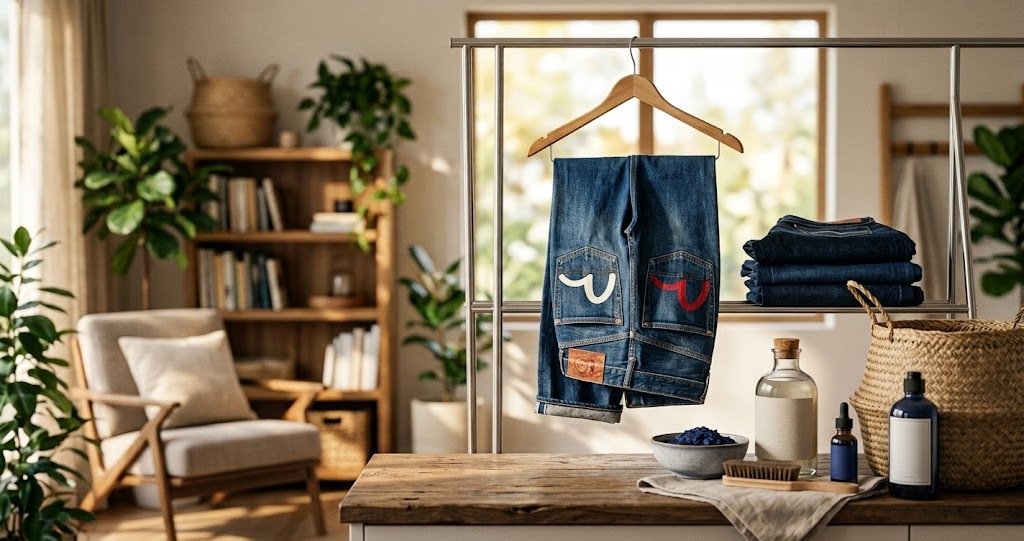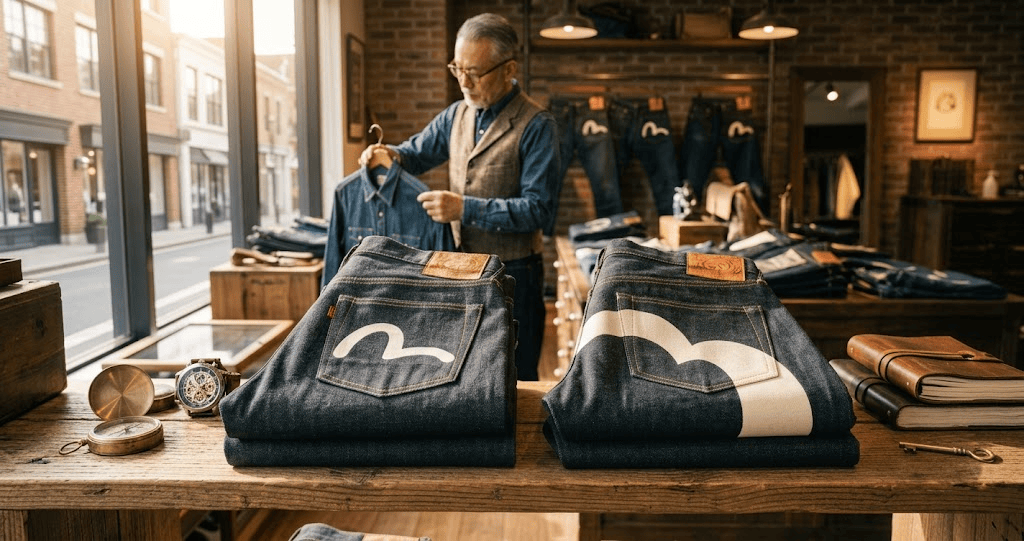

What is Japanese Selvage Denim? (And Why Evisu Uses It)

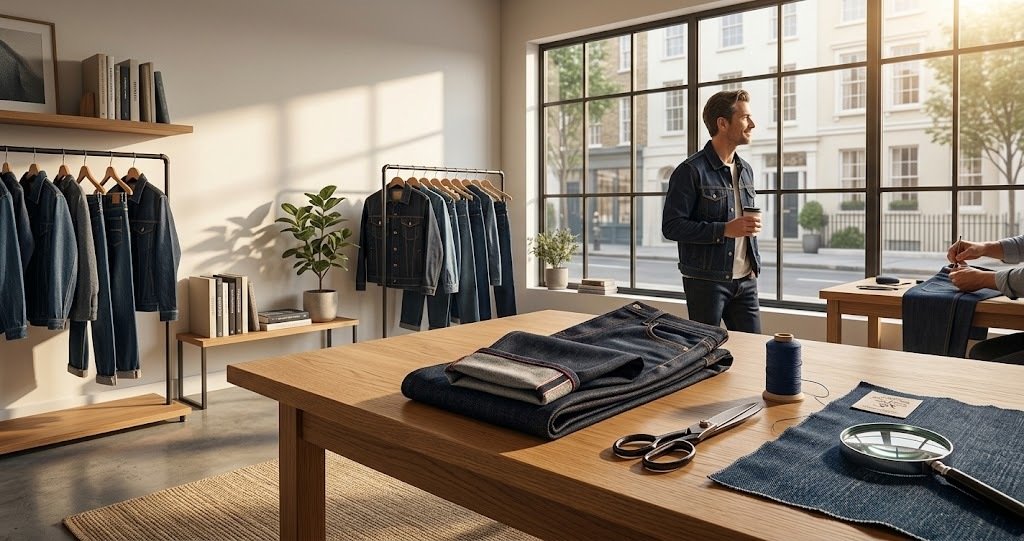
What is Japanese Selvage Denim? (And Why Evisu Uses It) is a question that comes up often when shoppers discover the distinctive denim behind EVISU jeans. The answer starts with the way the fabric is woven.
But selvage is more than a colored line hidden inside a cuff. The loom, yarn tension, indigo dyeing, fabric weight, finishing, and construction all influence how a pair of jeans feels and how it develops with wear.
EVISU has been closely associated with this style of denim since its founding in Osaka in 1991. The company says its early production was only around 14 pairs of jeans per day, with each pair receiving a hand painted seagull logo.
That small scale helps explain why EVISU became important to denim collectors. Its appeal was never simply about making another pair of blue jeans. It was about bringing traditional methods and visible craftsmanship back into modern fashion.
What Is Japanese Selvage Denim?
Japanese selvage denim is denim woven on narrow shuttle looms that produce a clean, finished edge on the fabric.
The term selvage, also written selvedge, comes from “self edge.” Instead of leaving the fabric edge open to fray, the shuttle loom carries the weft yarn back across the fabric, naturally forming a finished boundary.
This construction is different from the wide denim produced on modern projectile looms. Modern industrial looms can produce fabric much faster and in much greater quantities, while traditional shuttle looms are slower and create narrower widths.
That difference matters because the weaving process can influence the character of the finished cloth.
Japanese denim makers became famous for taking traditional equipment and using it with carefully selected yarns, unusual textures, indigo dyeing techniques, and detailed construction. The result is not one single “Japanese denim formula.” Instead, Japanese denim covers a broad range of fabrics with different weights, textures, colors, and fading behavior.
KOJIMA GENES describes Japanese selvage denim as high density fabric made on traditional shuttle looms, while also noting that Japanese mills continue to experiment with cotton varieties, dyes, colors, and heavier fabrics.
Is Selvage the Same as Raw Denim?
No.
This is one of the most important distinctions for anyone shopping for denim.
Selvage describes how the fabric is woven. Raw denim describes the condition of the fabric after production.
A pair of jeans can therefore be:
- Selvage and raw
- Selvage and washed
- Non selvage and raw
- Non selvage and washed
A raw pair has generally not undergone the same type of extensive washing or finishing used to give conventional jeans their final appearance.
Selvage, meanwhile, refers specifically to the fabric edge created during weaving.
So when someone says “Japanese raw denim,” they are not automatically talking about selvage denim. The two terms describe different characteristics.
How Does Japanese Selvage Denim Get Its Distinctive Edge?
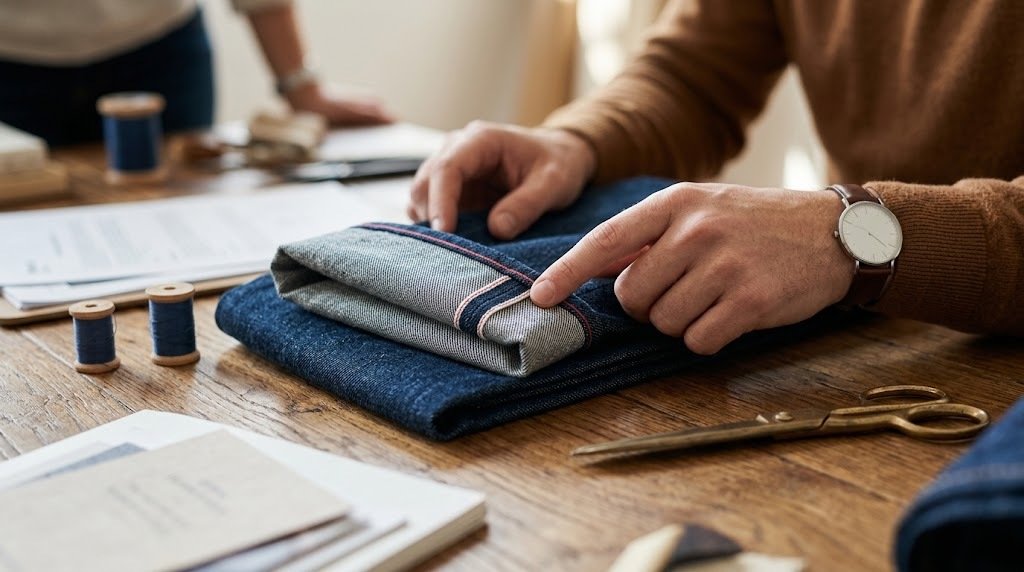
The easiest way to understand selvage is to look inside the cuff of a pair of jeans.
Traditional shuttle looms use a shuttle to carry the weft yarn back and forth across the warp. When the shuttle reaches the edge, the yarn loops back rather than being cut off in the same way it would be in many modern high speed weaving processes.
That creates the finished edge.
EVISU explains that its denim is produced on narrow shuttle looms and that the thread travels back and forth, creating the smooth edge associated with authentic selvage fabric. EVISU also says its selvage is usually identified with red and white coloring.
The colored line is called the selvage ID.
It can be red, blue, green, yellow, or another combination depending on the mill and fabric. The color itself does not determine whether denim is genuine selvage. What matters is the construction of the fabric edge.
That is an important buying lesson because a decorative colored line can be imitated. A true selvage edge is actually the finished edge of the woven fabric.
Why Do Denim Fans Cuff Selvage Jeans?
Cuffing the jeans can expose the selvage ID.
For enthusiasts, this is part of the visual language of heritage denim. It also lets the wearer see a detail that would normally remain hidden.
However, the selvage line is not a guarantee of superior quality by itself. Cotton quality, yarn, weave density, dyeing, fabric weight, sewing, finishing, and construction all matter too.
Why Does Evisu Use Japanese Selvage Denim?
EVISU’s relationship with selvage denim is closely connected to its original identity.
The brand was founded in Osaka in 1991 and named after Ebisu, the Japanese god of prosperity. EVISU says it initially produced approximately 14 pairs of jeans per day, each featuring its hand painted seagull logo.
Rather than treating denim as a disposable basic, EVISU built its identity around vintage inspired production and visible craftsmanship.
Its current “EVISU Rules” page says the brand’s jeans use authentic materials, vintage detailing, and original methods throughout production.
There are several reasons selvage fits that philosophy.
1. It Preserves Traditional Weaving
The narrow shuttle loom is closely associated with traditional denim production.
The slower process gives manufacturers a way to reproduce characteristics associated with older workwear denim. EVISU specifically describes its denim as being made in the traditional vintage way on original shuttle looms.
2. It Creates a Distinctive Texture
EVISU says its shuttle loom process creates a looser weave and rougher texture. That texture can change as the jeans are worn and washed.
For denim enthusiasts, this changing surface is part of the appeal.
A new pair may feel firm and structured. Over time, repeated bending, friction, washing, and movement can create whiskers around the upper thighs, honeycombs behind the knees, and other personalized fading patterns.
3. It Supports the Heritage Look
EVISU’s jeans combine traditional denim with details such as specific thread colors, distinctive buttons, labels, and the famous seagull design.
The result is a product that communicates its construction visually rather than hiding every manufacturing detail.

What Makes Evisu Denim Different?
The fabric is only one part of the story.
EVISU’s official construction guide identifies several details that contribute to the brand’s denim identity.
Denim Weight
EVISU states that its traditional denim typically weighs between 12.2 oz and 13.5 oz.
That puts many of these fabrics in a versatile middle range.
For a new wearer, 12 to 13 oz denim can offer a useful balance between substantial fabric and everyday wearability. It is noticeably more structured than lightweight fashion denim without entering the extreme heavyweight category.
This is one reason denim weight is worth checking when comparing jeans. “Japanese denim” alone does not tell you how heavy or stiff a pair will be.
Indigo Dyeing
EVISU says its deep indigo color is produced using a loop dyeing process in which yarns can be dipped up to 30 times.
The broader principle behind repeated indigo dipping is straightforward: the yarn is repeatedly exposed to dye and air, allowing the indigo color to build on the surface.
KOJIMA GENES explains that this type of dyeing can leave the yarn core lighter, which contributes to the contrast that appears as the jeans wear.
That is why two pairs of dark blue jeans can age very differently.
Threads and Stitching
EVISU says up to nine different threads may be used on a pair of jeans, with thread thickness and color selected according to the part of the garment.
That is easy to overlook when shopping online.
Look closely at the waistband, pockets, belt loops, inseam, and hem. Heritage denim often uses construction details as part of the visual design.
The Seagull
The hand painted seagull, also known as the kamome, is arguably EVISU’s most recognizable feature.
The brand says its early jeans were individually hand painted with the seagull logo.
EVISU’s current rules also describe the back pocket seagull as a signature of the artisan production process. Depending on the model, the motif may be hand painted, printed, or embroidered.
This matters because the seagull is not simply a logo placed on top of ordinary jeans. It became part of EVISU’s visual connection to customized and handcrafted denim.
How Did Japanese Denim Become So Important?
Japanese denim developed from a fascination with American workwear and vintage jeans.
KOJIMA GENES traces the country’s denim development back to the postwar period, when American jeans became highly influential among young Japanese consumers. Japanese manufacturers gradually developed their own production capabilities, including domestically produced denim fabrics and jeans.
By the late 1970s and 1980s, Japanese brands were studying vintage American jeans in detail and developing their own interpretations.
This period helped establish the reputation of Osaka and Okayama as important denim centers.
EVISU became part of this story in 1991. Its emphasis on vintage inspired construction, hand painted details, and traditional denim helped it stand apart from mass market jeans.
The brand eventually became strongly associated with streetwear and hip hop culture, particularly during the late 1990s and early 2000s. Industry guides and denim communities continue to reference this period as an important part of EVISU’s global cultural influence.
Japanese Selvage Denim vs. Regular Denim
The difference is easiest to understand by looking at the manufacturing process.
| Feature | Japanese Selvage Denim | Typical Mass Market Denim |
|---|---|---|
| Loom | Traditional shuttle loom | High speed modern loom |
| Fabric width | Narrower | Wider |
| Edge | Finished self edge | Cut edge |
| Production | Slower | Faster |
| Texture | Often more pronounced | Often more uniform |
| Fabric choices | Frequently experimental | Usually standardized |
| Aging | Often valued for individual fades | Usually designed for consistent appearance |
| Craft emphasis | High on heritage focused products | Varies by manufacturer |
This does not mean every selvage jean is automatically better.
A poorly designed selvage jean can still be uncomfortable or disappointing. Likewise, a non selvage pair can be well made and durable.
The advantage of Japanese selvage denim is that it gives the maker a different production foundation and allows greater emphasis on traditional weaving, fabric character, and detailed construction.
How Can You Tell If Jeans Are Selvage?
You do not need to be a denim expert to perform a basic check.
Step 1: Turn Up the Hem
Cuff the jeans or inspect the inside of the hem.
Step 2: Look for the Fabric Edge
A genuine selvage edge should look like the actual finished boundary of the woven fabric.
Step 3: Check the Selvage ID
You may see a colored thread running along the edge. EVISU commonly describes its selvage as red and white.
Step 4: Do Not Rely Only on the Color
A colored stitch or decorative detail can be misleading.
Recent denim community discussions show why this distinction matters. Enthusiasts have identified pairs that appear to have a selvage detail but do not actually have a true selvage edge.
That makes the fabric construction more important than simply spotting a red line.
Step 5: Check the Specific Model
This is especially important with EVISU.
Do not assume that every pair bearing the Evisu Jeans name has exactly the same fabric or construction. Different eras, collections, markets, and product lines can have different specifications.
If buying vintage or secondhand EVISU, inspect the actual garment rather than relying only on a seller’s description.

Does Japanese Selvage Denim Last Longer?
It can be extremely durable, but selvage construction alone does not guarantee longevity.
Durability depends on several factors:
- Cotton quality
- Yarn strength
- Fabric weight
- Weave density
- Stitching quality
- Seam construction
- How the jeans are worn
- How they are washed and dried
The strongest argument for quality Japanese denim is therefore not simply “selvage equals stronger.”
The better argument is that traditional denim production allows brands to control and emphasize many aspects of the fabric and garment, from yarn selection to weaving and construction.
For EVISU, that philosophy is visible in its stated use of traditional shuttle looms, vintage detailing, specialized threads, and distinctive finishing.
Why Does Japanese Selvage Denim Fade So Well?
Fading happens because indigo gradually wears away from areas that experience repeated friction.
Think about where your jeans bend and rub:
- Front pockets
- Upper thighs
- Behind the knees
- Seat
- Belt area
- Lower legs
These high friction areas can become lighter while areas with less friction remain darker.
This creates the personalized contrast that denim enthusiasts call fade patterns.
KOJIMA GENES highlights terms such as whiskers, honeycombs, and vertical fading as characteristic visual results of indigo denim wear.
The interesting part is that no two wear patterns are exactly identical.
That is one of the strongest reasons collectors value traditional denim. The jeans become a record of how their owner actually moves.
An Important EVISU Detail
EVISU says its shuttle loom denim has a rougher, looser texture and that wearing and washing allow the fabric to develop its own look and feel.
That makes the fabric an active part of the design.
The jeans are not necessarily supposed to look exactly the same after two years as they did on day one.
Is Evisu Denim Worth Buying?
For someone interested only in inexpensive everyday jeans, premium Japanese denim may not be necessary.
For someone who values fabric, construction, heritage, and distinctive design, EVISU can make much more sense.
You are paying for a combination of:
- Traditional denim production
- Fabric character
- Detailed construction
- Brand history
- Distinctive seagull artwork
- Potential for personalized fading
- Collectibility
The best approach is to judge a specific pair rather than the brand name alone.
Check the fabric weight, composition, country of production, fit, construction, and whether the model is actually selvage.
That last point is especially important for secondhand shoppers. Online denim discussions show that EVISU collectors sometimes encounter models whose construction is difficult to identify from photographs alone.
The Bottom Line: What Is Japanese Selvage Denim?
Japanese selvage denim is denim woven on traditional shuttle looms that create a finished fabric edge. It is valued for its distinctive construction, texture, craftsmanship, and ability to develop individual character through wear.
EVISU uses this traditional approach because it fits the brand’s original philosophy of vintage inspired denim craftsmanship. Its official specifications highlight shuttle loom weaving, deep indigo dyeing, 12.2 to 13.5 oz denim, specialized threads, distinctive hardware, and the signature seagull detail.
The key lesson is simple: selvage is about how the fabric is woven, not just how a pair of jeans looks.
If you are buying EVISU, look beyond the famous seagull. Check the actual fabric edge, model details, construction, and fabric specifications. That is where the real story of Japanese selvage denim begins.
For more guides on Japanese denim, streetwear, and heritage fashion, explore [INTERNAL LINK: Japanese Denim Style Guide].
Frequently Asked Questions About Japanese Selvage Denim
What is Japanese Selvage Denim?
Japanese selvage denim is denim woven on traditional narrow shuttle looms that create a finished edge along the fabric. It is valued for its construction, texture, craftsmanship, and distinctive aging characteristics.
Is Japanese selvage denim better than regular denim?
Not automatically. Selvage describes the weaving method, not an overall quality guarantee. Cotton quality, yarn, fabric weight, dyeing, stitching, and construction also determine how good a pair of jeans is.
Why does Evisu use selvage denim?
EVISU uses traditional selvage denim because it fits the brand’s heritage focused approach to denim. The company emphasizes shuttle loom weaving, vintage details, specialized threads, indigo dyeing, and craftsmanship.
How can you tell if Evisu jeans are selvage?
Turn up the cuff and inspect the actual edge of the denim. A genuine selvage edge is the finished boundary of the woven fabric. EVISU says its selvage is usually red and white, but color alone should not be used as proof.
Is selvage the same as raw denim?
No. Selvage describes how denim is woven, while raw denim describes denim that has not received the same type of extensive washing or finishing as many conventional jeans. A pair can be both selvage and raw, but the terms are not interchangeable.
Does Japanese selvage denim fade differently?
It can. Indigo yarn construction, weave characteristics, fabric texture, and how the jeans are worn all influence fading. Common patterns include whiskers, honeycombs, and vertical fades.