

The History of Evisu Jeans: Japan’s Iconic Denim Brand

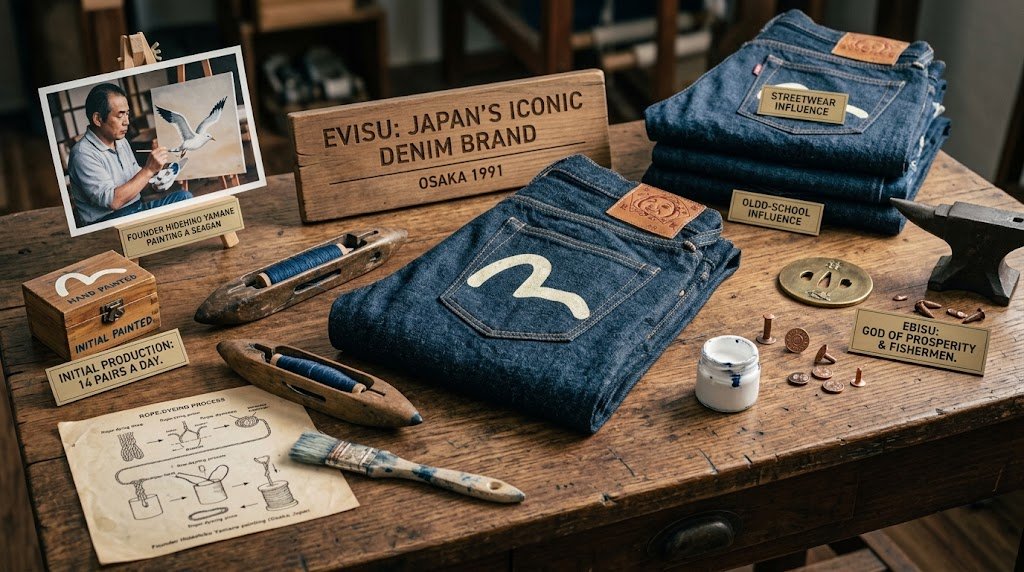
The History of Evisu Jeans: Japan’s Iconic Denim Brand begins in Osaka in 1991, when Hidehiko Yamane set out to recreate the character of vintage American denim through Japanese craftsmanship. What started as a small-scale denim project became an international symbol of selvedge denim, hand-painted details, Japanese fashion, and streetwear culture.
Evisu’s story is interesting because it was never simply about making another pair of blue jeans. Yamane looked backward—to American workwear and vintage Levi’s, Lee, and Wrangler designs—then rebuilt those ideas through Japan’s growing denim culture. The result was something recognizable but distinctly different.
Today, Evisu is known for its painted seagull motif, bold designs, premium denim, and strong connection to Japanese denim history. The brand’s official history says it was founded in Osaka in 1991 and named after Ebisu, the Japanese god of prosperity.
How Did Evisu Jeans Begin in Japan?
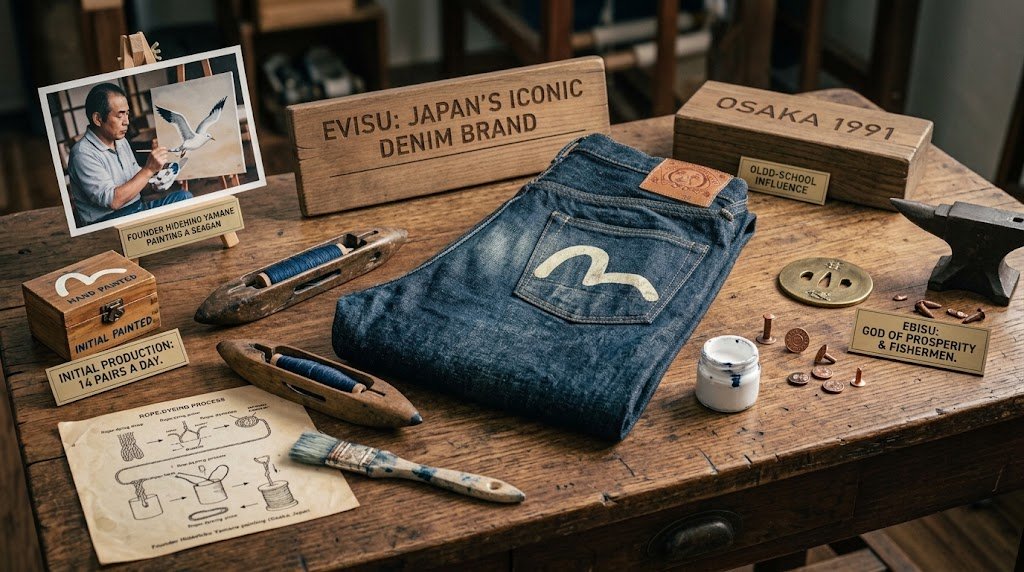
Evisu was founded in Osaka in 1991 by Hidehiko Yamane, a tailor and denim enthusiast with a strong appreciation for vintage American jeans. Long John’s historical account notes that the earliest operation could produce only around 14 pairs per day, emphasizing how different Evisu’s beginnings were from modern mass-market denim production.
The timing mattered.
During the postwar decades, Japanese consumers had developed a fascination with American clothing, especially classic jeans. This broader movement became associated with Ametora, or American-inspired Japanese fashion. Japanese enthusiasts were not simply buying American clothes; they were studying their construction, proportions, fabrics, and historical details.
Yamane took that fascination one step further.
Rather than produce inexpensive copies, he focused on recreating the look and feel of older American denim while using Japanese manufacturing expertise.
From Evis to Evisu
The brand was initially called Evis. According to Long John’s historical account, Yamane later added the “u” after encountering a trademark issue. The new name, Evisu, connected the brand to Ebisu, a Japanese god associated with prosperity and good fortune.
That small naming change became an important part of the brand identity.
The official Evisu history also identifies 1991 as the founding year and records the opening of its first shop, Old Hampshire Bond, in Osaka in April.
Why Is Evisu Famous for Its Seagull Logo?
The painted seagull is arguably the single most recognizable detail in Evisu Jeans.
Unlike conventional embroidered or woven back-pocket branding, Evisu became famous for applying the curved seagull—or kamome—by hand.
Long John reports that Yamane personally painted the motif during the brand’s early period. The first batch consisted of approximately 300 pairs, with the seagull initially painted on only part of the production. The painted pairs sold quickly, encouraging the brand to continue the practice.
That decision created something extremely important in fashion: recognition without relying on a conventional logo patch.
The seagull also had a historical connection to American denim. Painted arcuate designs had appeared on Levi’s jeans during World War II because wartime material restrictions affected how garments could be produced. Levi’s itself documents the use of a painted arcuate on its 1944 501 reproduction as a response to wartime rationing.
Evisu transformed that historical reference into its own visual language.
Seagull vs. Daicock
Over time, Evisu experimented with different interpretations of the motif.
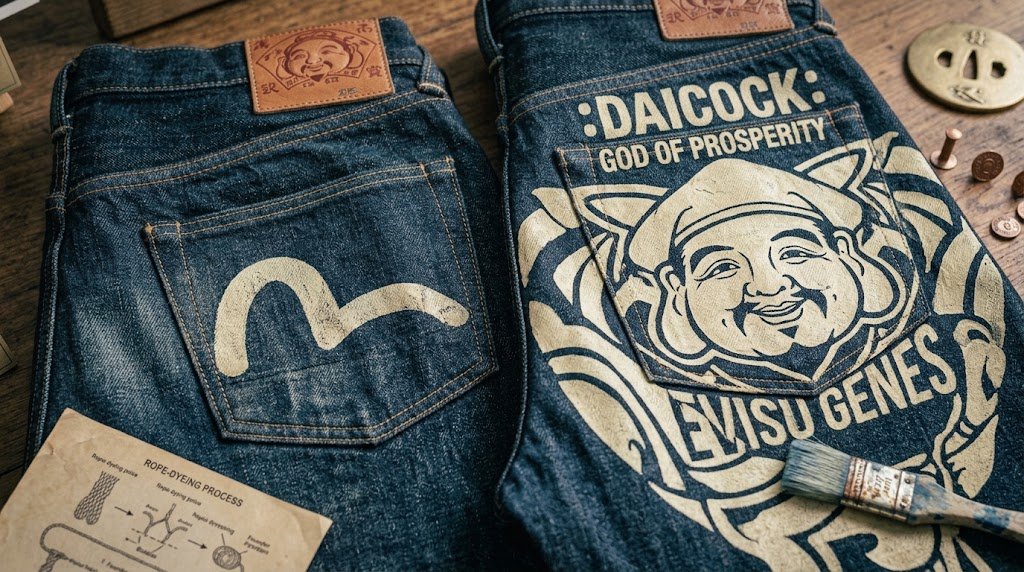
The classic Seagull normally appears across the back pockets. The Daicock, by contrast, is a much larger version that can extend dramatically across the rear of the jeans.
These details helped turn the back of an Evisu pair into a recognizable design surface rather than merely a place for functional pockets.
How Did Evisu Help Shape Japanese Selvedge Denim?
The history of Evisu cannot be separated from the revival of traditional Japanese denim production.
Vintage denim enthusiasts valued the fabric produced on narrow shuttle looms because the process creates a finished edge—known as selvedge—and a distinctive fabric character. Traditional shuttle looms are slower than modern projectile looms, but they became closely associated with premium Japanese denim.
Long John explains that traditional shuttle looms can produce roughly 100 meters of denim in 24 hours, with fabric widths around 70–80 centimeters.
That slower process helps explain why Japanese selvedge denim became associated with craftsmanship rather than mass production.
Evisu was part of a much wider Japanese movement that brought vintage denim construction back into the spotlight.
The Osaka 5
Evisu is often discussed alongside the group commonly known as the Osaka 5:
- Evisu
- Studio D’Artisan
- Denime
- Warehouse
- Fullcount
These brands helped establish Osaka as an important center of Japanese reproduction and selvedge denim culture during the 1990s. Their shared philosophy was heavily influenced by older American jeans, particularly 1940s and 1950s designs.
This is one of the most important parts of Evisu’s story: the brand did not create Japanese denim culture by itself, but it became one of its most visible international ambassadors.
The History of Evisu Jeans and the Global Denim Boom
By the late 1990s and early 2000s, Evisu had moved far beyond its original Japanese audience.
Denim enthusiasts in the United Kingdom, Europe, and eventually the United States became increasingly interested in Japanese-made jeans and raw denim. Evisu became one of the brands associated with that movement. Long John describes original Evis-branded jeans as collectible examples of the early period and credits the brand with helping introduce many denim enthusiasts to raw denim and natural fading.
This was also the period when Evisu became closely connected with streetwear and hip-hop culture.
The brand’s oversized graphics were visually different from the understated branding found on many traditional jeans. That made Evisu particularly noticeable in music videos, fashion editorials, and celebrity wardrobes.
Long John specifically identifies figures including Jay-Z, David Beckham, and Beyoncé among well-known people associated with wearing Evisu.
The cultural shift was significant. Evisu was no longer being viewed only as a specialist Japanese denim label. It had become a fashion statement.
From Denimhead Favorite to Streetwear Icon
The combination of premium denim and conspicuous graphics gave Evisu a distinctive position.
Traditional raw-denim enthusiasts could appreciate its construction and fading potential, while streetwear consumers could recognize the large seagull and Daicock graphics immediately.
That unusual overlap helped Evisu travel between different fashion communities.
It also explains why the brand remains relevant when discussing both Japanese denim history and early-2000s streetwear.
What Makes Evisu Jeans Different?
Evisu’s appeal comes from several elements working together rather than from one feature.
1. Japanese Denim Craftsmanship
Traditional production techniques and attention to fabric construction form an important part of the brand’s heritage.
2. Selvedge Denim
Selvedge construction became an important part of the Japanese denim revival. The finished edge is one of the easiest visual clues that distinguishes traditional shuttle-loom denim from many modern mass-market fabrics.
3. Hand-Applied Details
The hand-painted seagull gives Evisu a level of visual individuality that conventional machine-applied branding cannot easily reproduce.
4. Vintage American Inspiration
Evisu’s design language was heavily influenced by classic American workwear and vintage jeans. That influence was not hidden—it was part of the brand’s concept.
5. Strong Graphic Identity
The Seagull and Daicock motifs made Evisu immediately recognizable, particularly during the global streetwear boom.
Raw Denim vs. Selvedge Denim: What’s the Difference?
Evisu’s Most Interesting Collectible Pieces
Evisu’s history includes some unusually elaborate designs.
One particularly memorable example is the 21-pocket jean, which featured 21 pockets decorated with seagull motifs. Another remarkable release was the Millennium Edition, introduced in 2000 in a limited run of only 100 pairs. According to Long John, those jeans featured real gold yarn in the seagull embroidery, 24-karat gold buttons, and individually painted wooden boxes by Yamane.
Evisu also produced tribute designs referencing major American denim names.
In 2007, its European collection included a tribute series inspired by Levi’s, Lee, and Wrangler, incorporating different historical construction and branding references.
These releases demonstrate an important characteristic of Evisu: the brand treated denim history as something to reinterpret rather than simply preserve.
How Evisu Expanded Beyond Jeans
Although Evisu became famous through denim, the company eventually expanded into a much broader fashion business.
Its official history records collaborations and product expansions involving areas such as eyewear, footwear, headwear, and apparel. The brand’s timeline includes collaborations with names including New Era, Moleskine, Champion, Swarovski, Keith Haring, and Palace.
The official U.S. site today also presents Evisu as a broader lifestyle label with men’s and women’s clothing, denim, accessories, and multiple contemporary collections.
This evolution is important because it shows how the brand moved from a specialist denim workshop to a global fashion label.
What Is Evisu’s Legacy in Denim?
The biggest contribution of Evisu may not be a particular jean model or logo.
It is the idea that Japanese manufacturers could study American denim history, respect its construction, and reinterpret it with their own craftsmanship and cultural identity.
That approach helped change how consumers thought about jeans.
Before the Japanese denim revival became internationally influential, many shoppers viewed jeans primarily through the lens of large American brands. Evisu and other Japanese denim labels helped create a different conversation—one centered on fabric weight, shuttle looms, selvedge edges, stitching, fading, construction, and production history.
An Original Insight: Why the Seagull Mattered So Much
A useful way to understand Evisu’s success is to look at the contrast between craftsmanship and visibility.
Premium denim can be difficult to recognize from a distance. Fabric weight, weaving technique, and stitching are meaningful to enthusiasts but mostly invisible to everyone else.
The hand-painted seagull solved that problem.
It made the craftsmanship culture visible.
A person could recognize an Evisu pair from across a room without knowing anything about shuttle looms or raw denim. That combination—specialist construction underneath and unmistakable graphics on top—helped Evisu bridge the gap between denim enthusiasts and mainstream streetwear.
That is arguably one of the smartest design decisions in the brand’s history.
Evisu Jeans in 2026: Why the Brand Still Matters
More than three decades after its founding, Evisu remains relevant because its core visual language is difficult to confuse with another brand.
Its official history continues to emphasize the brand’s 1991 Osaka origins, while the current U.S. site continues to feature dedicated denim collections and Made-in-Japan offerings.
For collectors, older Evis and early Evisu pieces can represent an important period in Japanese denim history. For newer consumers, the brand offers a direct connection to the visual language that helped define premium Japanese streetwear.
The market has changed dramatically since 1991, but the fundamental idea remains familiar:
Take classic denim, obsess over the details, and give it a distinctly Japanese identity.
Best Japanese Denim Brands to Know
Frequently Asked Questions About Evisu Jeans
When was Evisu founded?
Evisu was founded in Osaka, Japan, in 1991 by Hidehiko Yamane. The brand’s official history confirms the 1991 founding date.
Why is Evisu called Evisu?
The brand was initially known as Evis. After a trademark issue, Yamane added the “u,” creating Evisu. The name also connects to Ebisu, the Japanese god of prosperity and good fortune.
What does the Evisu seagull mean?
The seagull is Evisu’s signature visual motif. It was originally hand-painted onto the back pockets and became one of the brand’s defining characteristics.
Is Evisu a Japanese brand?
Yes. Evisu was founded in Osaka, Japan, and its identity is strongly connected to Japanese denim craftsmanship and the country’s vintage-denim revival.
Why are Evisu Jeans popular?
Evisu became popular because it combines Japanese denim craftsmanship, vintage American influences, distinctive hand-painted graphics, and a strong connection to streetwear culture.
Are old Evisu Jeans collectible?
Some vintage and limited-edition Evisu pieces are highly sought after by denim collectors. Rarity, age, condition, construction, graphics, and provenance can all influence collector interest.
Conclusion: The History of Evisu Jeans Is a Story of Reinvention
The History of Evisu Jeans: Japan’s Iconic Denim Brand is ultimately a story about cultural exchange.
American jeans inspired Japanese enthusiasts. Japanese craftsmen studied those garments in extraordinary detail. Evisu then transformed those influences into something recognizable around the world.
From a small Osaka operation in 1991 to an internationally recognized fashion label, Evisu helped make Japanese denim part of the global conversation.
The hand-painted seagull became its calling card. Selvedge denim became part of its craft story. Streetwear and hip-hop helped introduce the brand to a much wider audience.
And that combination is what makes Evisu more than just another jeans brand: it is a case study in how fashion history can be borrowed, studied, rebuilt, and ultimately reinvented.
For readers interested in Japanese denim, Evisu offers an excellent starting point for understanding how Japan became such an influential force in modern denim culture.
Explore more denim history: Japanese Denim History and Brand Guides
Author note: This article should be reviewed against current Evisu product and brand information before publication. Evisu’s official history is the primary source for brand milestones, while independent denim sources provide historical and cultural context.
Suggested authoritative external sources:
- EVISU Official History
- Levi’s 1944 501 Historical Details
- Long John: Evisu History
3. FAQ Section
1. When was Evisu founded?
Evisu was founded in Osaka, Japan, in 1991 by Hidehiko Yamane.
2. What is Evisu famous for?
Evisu is best known for premium Japanese denim, its hand-painted Seagull logo, selvedge construction, and its influence on global streetwear.
3. Why does Evisu have a seagull on its jeans?
The hand-painted seagull became Evisu’s signature design after Yamane used the motif on early jeans. Its distinctive appearance helped separate Evisu from other denim brands.
4. Is Evisu made in Japan?
Evisu was founded in Japan and has a strong Made-in-Japan denim heritage. However, consumers should check the country-of-origin information for the specific model they are considering.
5. What is the difference between Evisu Seagull and Daicock?
The Seagull is the classic curved motif placed across the back pockets, while the Daicock is a larger graphic that can extend across the rear of the jeans.
6. Why is vintage Evisu important to denim collectors?
Early Evis and Evisu pieces document the development of Japanese reproduction denim and the global rise of premium raw and selvedge jeans. Limited editions and unusual historical designs can be especially interesting to collectors.